
31 August 2026
Honouring the unseen work of peacekeepers
As a self-described fourth-generation “Army brat”, Scott Klima seemed destined for military life from the very beginning.
“My dad, grandfather and great-grandfather all served,” he shares.
“My dad's an ex-1RAR soldier and went to Somalia back in the early 90s. When I finished school, my mum thought the Army would give me financial stability, but it was really my dad who influenced my decision.”
In 1987, Scott enlisted for the first time, graduating from Duntroon in 1990. He served until 1995 before taking a break and rejoining in 2004.
“When I left, I found it difficult to regain the sense of purpose and meaning I had in the Army. No job really compared – especially in the corporate world,” Scott says.
“I'm the only idiot that will ever graduate from Duntroon twice. I like to think it proved that I wanted to be there. It certainly helped me out in the early parts of my career. Now I look back at it as a funny part of my story.”
Only one year after Scott rejoined the Army, he received his first mission overseas.
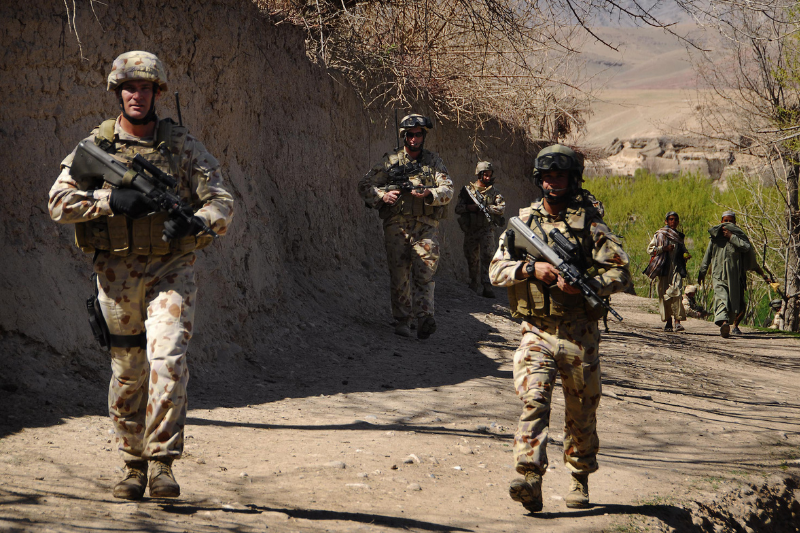
From 2005 to 2006, Scott was deployed to Iraq as a Cavalry Troop Leader with the Australian Security Detachment in Baghdad, and again from 2008 to 2009 for his first tour of Afghanistan as the Second in Command of the Force Protection Combat Team. In 2010, he returned to Afghanistan as the Chief of Operations for the US Army-led Combined Team Uruzgan.
Scott describes these deployments as intense and extremely busy amidst the ever-changing political climate.
“I was always fearful of not being able to get my guys enough information and training to be ready for whatever occurred. In Iraq, we were rocketed three or four times a day in the Green Zone. Those were very protracted, noisy engagements,” he reflects.
Scott (far left) on patrol during deployment in 2009.
Cooking and looking
In 2013, Scott was deployed on his first peacekeeping mission with the United Nations Truce Supervision Organisation (UNTSO), based primarily on the Golan Heights between Israel and Syria.
“Our main role was to monitor the cessation of hostilities between Israel and Syria because there wasn’t an official peace agreement in place. Since the 1974 Agreement on Disengagement between Israel and Syria, Australia had provided up to 12 military observers every year, and I was one of them. In my team of 12, there were soldiers from 10 different nations,” Scott explains.
“We called our job ‘cooking and looking’ because there was a very defined set of things that you had to monitor and observe to be able to report effectively. Ironically, I probably saw more kinetic action in my 12 months with the UNTSO than I did during my two tours in Afghanistan.”
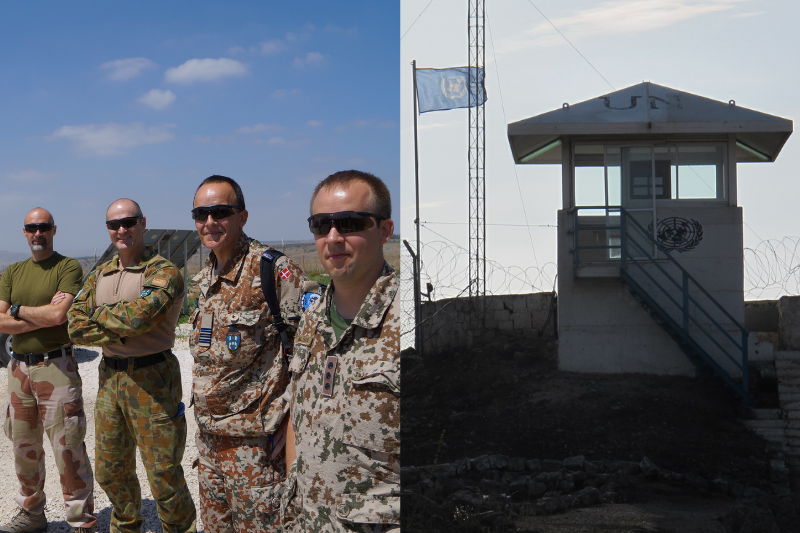
Scott was a member of Team Wadi – one of three teams on the border who looked after six operational observation posts (OP). Team members would work in shifts to monitor the border 24/7, only leaving to change guard, and inspect the area of separation and disengagement which stretched 25km on either side of the border.
Scott (second left) with Team Wadi, and Observation Post 54 on the border of Israel and Syria.
Three months later, tensions in the area escalated. ISIS troops launched a ground offensive which led to a period of intense fighting between the two nations. At one point, Scott and his team were only 800 metres from the Syrian Army position and surrounded by a grass fire.
“I was getting phone calls from the Israeli Defense Force (IDF) about the situation because I was cut off. I couldn't go anywhere. Our OP became a casualty collection point for the ISIS fighters during one of their operations. The IDF later positioned a tank next to the OP to help with our security. It got pretty hairy there for a while,” he recalls.
In recognition of his work as a Military Observer throughout his 12-month deployment, Scott was awarded a Force Commander’s Commendation from the United Nations Disengagement Observer Force (UNDOF) in 2013.
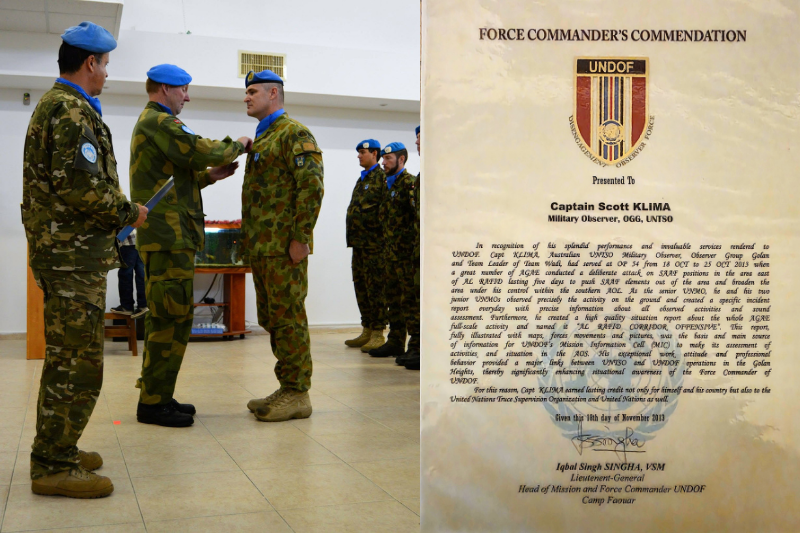
Scott receives the Force Commander’s Commendation from the United Nations Disengagement Observer Force (UNDOF).
Peacekeeping
Following a medical discharge from the Army in 2024, Scott now reflects on his service both at home and abroad.
“While you're there, you're doing a job. You acknowledge that there's a threat there, but it doesn't override what you do day to day. It's like jumping off a jungle gym when you're six years old. When you land, it hurts a little bit and you go, ‘Oh, I’m glad I didn't break anything.’ It's sort of like that. You look back and think, ‘Damn, I was pretty lucky to get through that without too many battle scars.’”
Scott says commemorations like National Peacekeepers’ Day (14 September) not only acknowledge the risks that Military Observers and Peacekeepers face every day, but also honour the often-unseen role Australian forces play in global peacekeeping.
“When I do school visits or talk to people on behalf of the RSL these days, I don't talk about the combat side of things. I talk about our purpose, which is creating an environment that is safe and secure for people,” he says.
“Peace means different things to different people around the world. For me in UNTSO, peace is knowing that a student no longer has to worry about where the nearest bomb shelter is. They can go to school and just concentrate on their studies, playing and being a kid.”
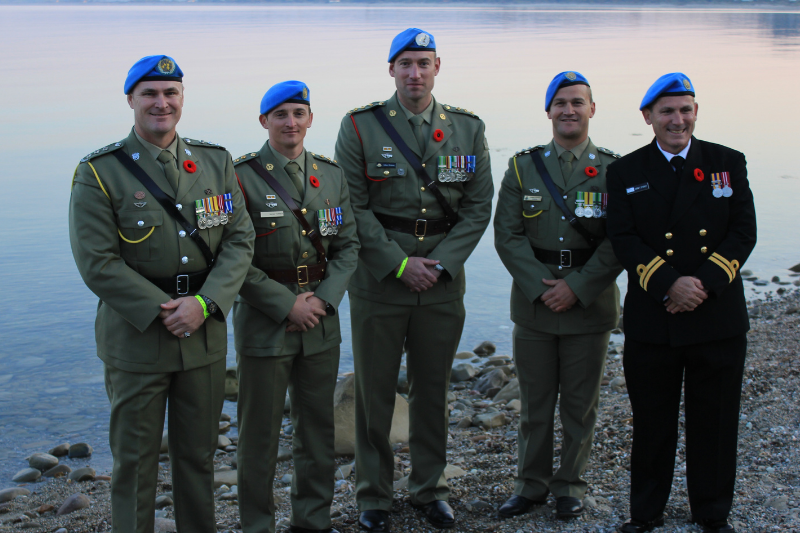
Scott (far left) with fellow UNTSO members at the original ANZAC landing site in 2013.
Finding purpose after service
After 22 years in Defence, Scott has now found a new purpose with his local RSL Sub Branch in Townsville. He says reconnecting with ex-Defence personnel and current serving members has helped him bridge the gap between service and civilian life.
“I always identified myself as a soldier. So, if I’m not a soldier anymore, what am I?” Scott says.
“When you leave the military, that in-built support network just disappears. You've got to find your own sporting team, your own doctor, and your own social group. You just take it for granted."
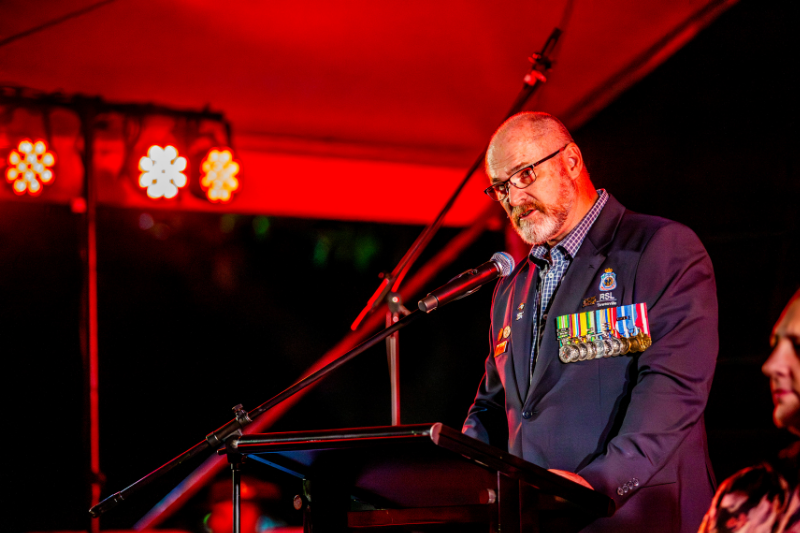
“Getting involved with the RSL has really given me back some of the purpose and connection I’d been missing. Now, I’m the MC for various commemoration services, I help coordinate monthly social activities like whale watching and abseiling, and have also played an active role in our school outreach initiatives like Postcards of Honour and Draw to Remember.”
Scott addressing the crowd at Townsville RSL Sub Branch ANZAC Day service.
In the future, Scott hopes to take on more of a leadership role within the RSL District, and help further develop the Sub Branch, so that even more veterans and serving members can experience the benefits of community and camaraderie.
“The RSL has been a part of the veteran community for over 100 years, and I want to make sure it’s around for another 100 years to support veterans, and the wider community,” he says.
Join your local RSL Sub Branch
Find out more information on how to join your local RSL Sub Branch.